Racking & Shelving Specialists — Hamriyah Free Zone, Sharjah · Serving the UAE & GCC

As an established industrial rack and structural mezzanine exporter, our factory delivers turnkey storage systems designed to maximize vertical warehouse cubic space, ensure rigorous safety compliance, and withstand demanding operational cycles.
Selecting industrial elevated platforms requires precise mathematical modeling of dead loads, live loads, seismic accelerations, and structural deflection limits. Discover how modern Chinese structural steel mezzanine exporters deliver global engineering compliance.
Industrial elevated flooring systems represent the single most economical method for doubling or tripling usable interior facility square footage without undertaking cost-prohibitive commercial brick-and-mortar expansion. In modern supply chain architecture, structural steel mezzanines serve as mission-critical elevated staging areas, Automated Guided Vehicle (AGV) sorting decks, e-commerce order fulfillment catwalks, and multi-tier production platforms.
In international structural design, elevated mezzanine platforms fall into three primary structural design categories, each governed by specific steel specifications, clear span possibilities, and floor slab load requirements:
Fabricated using hot-rolled wide flange beams (ASTM A36 / ASTM A572 Grade 50 or Chinese Q355B structural sections) and heavy square structural hollow sections (SHS). These systems deliver massive clear spans (up to 12 meters between columns), supporting point loads exceeding 2,500 kg/m² for heavy tooling, office enclosures, or forklift operations.
Utilizing heavy-duty selective pallet racking uprights or drive-in upright frames as the vertical load-bearing columns. This topology is optimal for high-density logistics distribution centers where palletized storage beneath the platform matches piece-picking catwalk decks above, drastically slashing raw material tonnage and total system cost.
Engineered with high-tensile cold-formed steel sections, creating 2, 3, or 4 levels of walk-around aisles integrated seamlessly with light or medium-duty longspan shelving frames. This design maximizes vertical item accessibility for pharmaceutical, garment, and small-parts e-fulfillment hubs requiring manual hand picking.
World-class steel mezzanine exporters configure all structural calculations according to ANSI/AISC 360 (Specification for Structural Steel Buildings), Eurocode 3 (EN 1993), and AS 4100 standards. Steel raw materials are strictly sourced with 3.1 Mill Test Certificates (MTC) verifying chemical yield, tensile strength, and impact resistance.
Structural deflection criteria represent the defining benchmark separating consumer shelving from engineering-grade industrial mezzanines. Under full Uniformly Distributed Load (UDL), primary support girders and secondary floor joists must maintain vertical deflection tolerances no greater than L/360 to L/480 of the clear span for standard foot traffic and dry storage, and L/600 when supporting sensitive Autonomous Mobile Robots (AMRs), high-speed belt sorters, or modular cleanroom walls.
| Mezzanine Topology | Structural Steel Grades | Max Span Between Columns | Uniform Distributed Load (UDL) | Ideal Application Sector | Primary Decking Options |
|---|---|---|---|---|---|
| Heavy Structural Column Mezzanine | Q355B / ASTM A572 Gr. 50 (Hot-Rolled H-Beam) | 6.0m – 12.0m | 800 – 2,500 kg/m² | Machinery Platforms, Heavy Manufacturing, Office Buildouts | Bar Grating / Checker Plate |
| Rack-Supported Mezzanine Floor | Q235B / Cold-Formed High Tensile Steel | 2.7m – 4.5m | 500 – 1,200 kg/m² | 3PL Logistics, Bulk Pallet Under-Deck, FMCG Distribution | 25mm Biga Floor / Steel Deck |
| Multi-Tier Catwalk Shelving | Q235B Cold-Rolled Galvanized Sections | 1.2m – 2.4m | 300 – 600 kg/m² | Apparel, E-Commerce Parcel Picking, Auto Spare Parts | Perforated Galvanized Steel |
| Cantilever-Integrated Mezzanine | Q355B Uprights & Heavy Base Assemblies | 3.0m – 6.0m | 400 – 1,000 kg/m² | Pipe Distribution, Timber Yards, Steel Profile Wholesalers | Open Steel Mesh / Solid Plywood |
Global supply chain leaders and warehouse engineering teams are evolving their procurement paradigms. Sourcing elevated structural platforms from China now emphasizes digital precision, pre-engineered modularity, and automated robotic integration.
Procurement teams are eliminating on-site hot-work permits, welding inspections, and fire-hazard liability. Modern exporters utilize multi-axis CNC laser cutting and robotic punching to create 100% bolt-together beam-to-column connections using Grade 8.8 and 10.9 high-strength structural bolts, slashing overseas installation time by up to 65%.
With the rapid adoption of Autonomous Mobile Robots (AMRs) in multi-tier fulfillment hubs, procurement specifications now mandate ultra-flat, high-abrasion resin composite decking substrates. Elevated mezzanine floors require specialized joint transitions, vibration dampening, and conductive electrostatic discharge (ESD) surfaces to ensure robot wheel traction and optical navigation precision.
Leading international buyers now require structural mezzanine exporters to supply full Autodesk Revit (IFC) BIM models prior to steel fabrication. Digital twin integration allows mechanical, electrical, plumbing (MEP), and in-rack fire sprinkler engineers to detect spatial clashes digitally, ensuring frictionless integration with warehouse automation conveyors and lifts.
Driven by ESG mandates and rising international ocean freight tariffs, structural designers are shifting from traditional heavy mild steel to high-strength, low-alloy (HSLA) steel profiles. By utilizing thinner webs with high-frequency roll-formed stiffeners, total structural steel deadweight is decreased by 18-24% without sacrificing structural moment capacity.
As international building authorities heighten oversight, procurement contracts mandate third-party certified finite element analysis (FEA). Exporters must provide complete seismic structural calculations validating base-plate anchorage, diagonal bracing tension, and frame moment resistance tailored to the buyer's exact local earthquake zone and geotechnical soil class.
Procurement policies are phasing out low-VOC wet paints in favor of thermoset polyester electrostatic powder coatings and continuous hot-dip pre-galvanization. Engineered for corrosive maritime or humid warehouse environments, these finishes achieve C3 to C5-M industrial corrosion ratings under ISO 12944, guaranteeing 15+ years of maintenance-free operation.
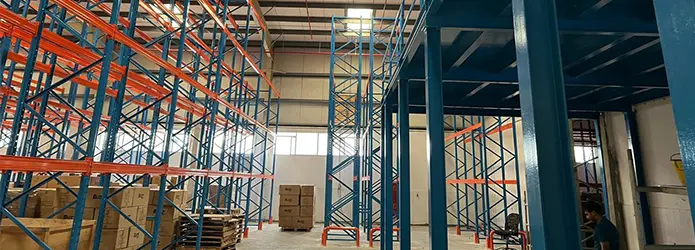
Backed by over three decades of accumulated industrial storage and racking fabrication experience, we maintain advanced Free Zone manufacturing logistics hubs, multi-axis automated roll-forming lines, and comprehensive finite element structural testing protocols.
Every beam, column, connector clip, and baseplate is manufactured under ISO 9001 certified controls. Automated ultrasonic weld inspections and spectrometer chemical analysis ensure defect-free structural integrity before container dispatch.
No two warehouse footprints are identical. Our dedicated structural design engineers calculate column placements around building columns, loading docks, fire escape egress, and overhead lighting to ensure 100% space utilization.
Component bundles are packed with edge-protection steel strapping, waterproof shrink wrapping, and custom steel pallet frames to prevent transit deformation inside 40ft High Cube containers across worldwide ocean transit.
From initial warehouse system study to site delivery and load commissioning, our structural execution framework guarantees transparent communication, structural compliance, and on-time milestone fulfillment.
Comprehensive analysis of clear roof heights, floor slab core sample data, material handling equipment turning radiuses, SKU velocities, and budget requirements.
Development of CAD floorplans, 3D BIM spatial models, and finite element analysis (FEA) verifying live loads, seismic drift, and beam deflection ratios.
Continuous CNC roll-forming, laser profiling, robotic welding, and automated shot blasting followed by electrostatic powder coating and batch load testing.
Precision container packing optimization minimizing freight dead-space, complemented by complete export documentation, customs packing lists, and assembly tagging.
Detailed color-coded 3D installation blueprints, step-by-step video manuals, anchor torque specifications, and remote engineer video supervision.
Technical, engineering, and logistical answers to assist global warehouse facility managers, EPC contractors, and procurement executives in making informed structural decisions.
To produce a certified engineering calculation and competitive quotation, our structural engineering team requires: (1) Architectural warehouse CAD drawings indicating interior clear height under beam, (2) Concrete slab thickness and compressive strength (e.g., 150mm–200mm, 25–30 MPa), (3) Required live load capacity per square meter (typically 300kg/m² to 2000kg/m²), (4) Desired column grid layout, and (5) Local seismic zone coefficient or geographical project coordinates.
Hot-rolled steel (e.g., Q355B / ASTM A36 wide-flange H-beams) features thick cross-sections, providing extreme torsional rigidity and wide column spans (6m to 12m), ideal for heavy manufacturing, concentrated machinery loads, and high forklift traffic. Cold-formed steel (e.g., C-sections, Sigma sections) is roll-formed from high-tensile galvanized sheet coils at room temperature, delivering an exceptional strength-to-weight ratio for multi-tier hand-pick catwalks and cost-sensitive light industrial storage.
The choice of decking depends directly on operational use: (1) Heavy-Duty Steel Bar Grating: Best for fire sprinkler water penetration, light airflow, and industrial workshops, (2) Embossed Steel Checker Plate: Impermeable, fireproof, and high skid-resistance for pallet truck handling, (3) Biga Engineered Wood / High-Density Fiber Resin Deck: Excellent sound absorption, smooth wheel rolling for AGVs and order carts, and (4) Perforated Steel Plank Decking: Lightweight, economical, and pre-galvanized for manual picking catwalks.
Our structural engineering department performs dynamic response spectrum analysis and linear static calculations using finite element modeling software. We evaluate structural behavior against ASCE 7 (Minimum Design Loads for Buildings), Eurocode 8 (Design of Structures for Earthquake Resistance), and the International Building Code (IBC). Full stamped engineering calculation dossiers are provided for local municipal permitting and safety authority sign-offs.
All structural steel elements undergo protective export bundling protocols. Primary H-columns and main girders are cushioned with custom timber dunnage and heavy-duty steel bands. Secondary C/Z purlins and edge safety kickplates are nested into uniform strapped packs. All connection cleats, Grade 8.8 structural bolts, baseplates, and leveling shims are packed inside sealed, steel-reinforced wooden crates to ensure zero corrosion and zero deformation during sea transit.
Yes. Secondary floor purlins and primary girders are engineered with standardized, pre-punched utility conduit slots along their neutral structural axis. This allows electrical contractors, HVAC installers, and fire protection teams to hang sprinkler pipes, LED light fixtures, and emergency exit signage directly using standard beam clamps without drilling into or weakening the structural steel members.
All industrial staircases, perimeter handrails, and pallet drop gates comply with OSHA 1910.28, EN ISO 14122-3, and AS 1657 safety codes. Handrail systems measure at least 1,100mm in height, featuring intermediate knee rails and 100mm solid steel toe kickplates to prevent tools from rolling off the platform deck. Pallet loading safety gates are available in counterweighted pivot, sliding, or double-safety swing configurations.
Importing pre-engineered structural steel mezzanines from a top Chinese exporter yields total landed cost savings ranging from 30% to 50% compared to local structural fabricators. Economies of scale in raw steel procurement, automated robotic manufacturing, zero on-site hot work, and high-density container loading make direct factory importation the global procurement benchmark for large-scale distribution operations.