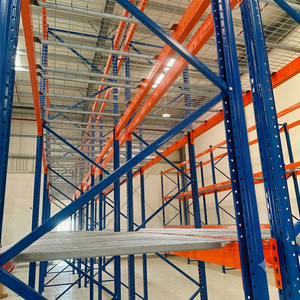
Racking & Shelving Specialists — Hamriyah Free Zone, Sharjah · Serving the UAE & GCC

Direct factory wholesale supply for selective pallet racks, heavy-duty box beams, and step beams engineered to strict international safety and loading thresholds.
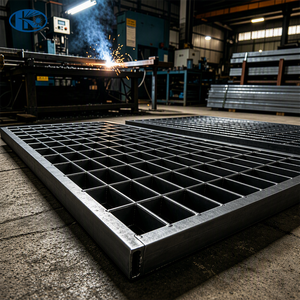
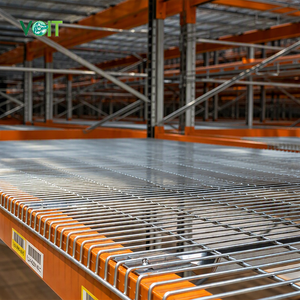
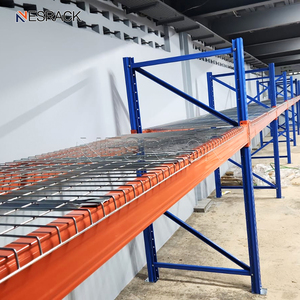
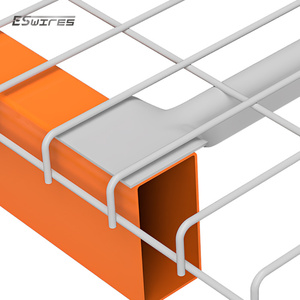
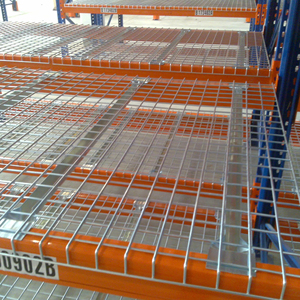
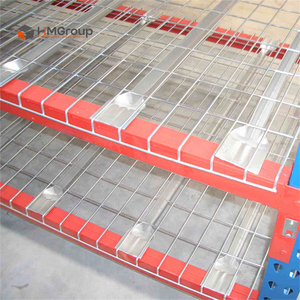
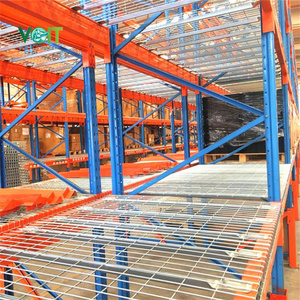
Wire mesh decking serves as the vital safety backbone for contemporary intralogistics infrastructure, cold-chain distribution centers, and high-density warehouse storage systems. Designed primarily to span structural crossbeams, welded wire panels prevent loose carton deflection, avert undersized pallet fall-through incidents, and dramatically enhance workplace safety under heavy cyclic loading. Compared with traditional solid wood timber decking or solid steel plates, open wire mesh allows unhindered illumination penetration throughout high-bay racking systems and eliminates solid surface dust accumulation. Crucially, it provides compliant open surface area ratios that permit ceiling sprinkler fire suppression systems to discharge uninhibited through all rack elevations in strict adherence to NFPA 13 building fire safety codes.
As premier Chinese manufacturers, our facilities combine computerized multi-point resistance welding arrays with high-tensile cold-drawn low-carbon steel wire (Q235 / Q195 grades) to fabricate decking assemblies with exceptional dimensional tolerances and uniform load distribution. Every welded intersection is subjected to shear stress testing to guarantee structural continuity under both Uniformly Distributed Loads (UDL) and localized dynamic impact stresses imposed by high-throughput forklift operations.
Optimizing beam-to-deck compatibility is essential for both static stability and rapid warehouse installation. The structural channel welded below the mesh panel dictates compatibility with specific beam geometry:
| Channel Type | Compatible Rack Beam | Structural Load Distribution | Primary Industrial Application |
|---|---|---|---|
| Standard Step Channel (U-Channel) | 1-5/8" or 1-1/2" Step Beams | Vertical flange rests flush inside the step profile, concentrating load transfer directly down through beam ledges. | Standard selective pallet racking, eCommerce order fulfillment hubs, high-density distribution centers. |
| Flared Universal Channel | Box Beams, Structural C-Channels & Step Beams | Flared, flattened end-plates extend horizontally across top beam surfaces, avoiding lip obstructions. | Retrofit facilities, heavy-duty structural pallet racks, unstepped structural channel frameworks. |
| Inside Waterfall / Drop-In Style | Specific Step Beams with zero overhang | Sits recessed completely inside beam step; eliminates outer lip to provide obstruction-free barcode scanning along beam faces. | Automated Storage & Retrieval Systems (ASRS), picking levels requiring flush magnetic labels. |
| Inverted Flange (F-Channel) | Cleanroom Sanitary Box Beams | Channel profile faces downward to prevent internal dirt, carton fibers, or moisture accumulation. | Pharmaceutical production, food and beverage processing, cleanroom storage environments. |
Electro-galvanizing (zinc plating) provides exceptional indoor durability, while Hot-Dipped Galvanizing (HDG according to ASTM A123) and high-adhesion outdoor thermoset polyester powder coating guarantee decades of service life in corrosive environments, sub-zero cold storage facilities, and high-humidity coastal zones.
Every batch of wire mesh decking engineered in our manufacturing plant conforms stringently to ANSI MH26.2 standards. Rigorous finite element load simulations ensure that under full rated UDL conditions, maximum deflection does not exceed 1/180th of the span, preventing plastic deformation.
High-speed automated CNC mesh welding lines, combined with robotic channel positioning welders, ensure clean, burr-free welds. This protects operators handling cartons, minimizes snagging hazards, and provides absolute dimensional repeatability container after container.
As logistics operations transition toward automated guided vehicles (AGVs), Autonomous Mobile Robots (AMRs), and multi-tier mezzanines, the engineering requirements for wire mesh decking have evolved substantially. Procurement directors are no longer purchasing commodity steel grids; they are sourcing integrated structural sub-systems that interface seamlessly with automation sensors, anti-drop backstops, and zoned fire isolation barriers.
Standard 2" x 4" (50 x 100 mm) wire spacing, while ideal for standard timber or plastic pallets, is rapidly giving way to dense 1" x 4" or 2" x 2" configurations. This shift is driven by the explosive growth of omni-channel retail distribution, where individual carton picking, plastic tote storage, and point-load concentrated carton weights are common. Denser grid patterns prevent small containers from tilting or falling through between wires, ensuring continuous operation of AMR sorting shuttles without manual system resets.
Supply chain leaders face mounting regulatory scrutiny surrounding decarbonization, environmental sustainability, and lifecycle emissions. Traditional post-weld electroplating and acid-pickling methods are being augmented by pre-galvanized Zinc-Aluminum-Magnesium (ZAM) alloys and advanced eco-friendly electrostatic powder finishes. ZAM coatings offer self-healing edge corrosion resistance up to four times greater than standard electro-galvanized finishes, significantly extending product lifecycles in cold-chain and humid environments while reducing total carbon footprint during manufacturing.
Global rack integrators and distributors are optimizing procurement margins by bypassing non-manufacturing intermediaries and securing factory-direct partnerships in China. By combining precision CAD drafting, strict ISO 9001 quality audits, consolidated ocean container nesting packaging (which drastically reduces ocean freight volume), and localized technical deployment, logistics developers realize 20% to 35% overall capital expenditure savings without compromising structural warranties.
Built upon a robust foundation of over 36 years of industrial racking and warehousing expertise across complex markets, our enterprise delivers comprehensive storage architecture. We operate on a fully integrated workflow—beginning with in-depth site system studies, architectural floor slab loading calculations, handling equipment compatibility analysis, followed by high-capacity precision fabrication, automated surface finishing, and end-to-end quality assurance before dispatch.
Our dedicated manufacturing infrastructure boasts modern high-tonnage roll forming machinery, automated wire mesh welding platforms, and dedicated powder coating facilities. We specialize in both standardized volume supply (such as classic 46"x42", 46"x48", and 52"x42" dimensions) and custom-engineered heavy industrial decks supporting upwards of 1,500kg per tier. From Hamriyah Free Zone, Sharjah to logistics hubs across the GCC, North America, and Europe, our engineering teams provide full after-sales support, load certifications, safety inspections, and turn-key warehouse rack optimization.
We do not simply manufacture components; we conduct full physical floor, product flow, and dynamic weight analyses, tailoring every wire gauge and channel thickness to your rack manufacturer's specific beam step profile.
Every production run undergoes weld integrity testing, salt spray corrosion evaluations (ASTM B117), and deflection stress tests to verify maximum structural stability prior to maritime shipment.
Decks are nested using protective edge protectors, structural wooden battens, and moisture-barrier shrink wrapping to maximize container cube utilization and ensure damage-free unloading on site.
Industry standard notation specifies Deep Dimension (D) first, followed by Width (W)—for example, 42" Deep x 46" Wide. The depth represents the beam span from front upright to rear upright, whereas width denotes the lateral dimension running along the horizontal beam face. Specifying the exact beam profile (step depth, step width, or box beam) ensures channel fitment without interference.
Unlike plywood or solid steel decking that creates continuous horizontal thermal barriers, open wire mesh decking (typically >70% open surface area) allows early convective heat detection by ceiling-mounted sprinkler sensors. Moreover, fire sprinkler discharge flows directly down through all rack levels, suppressing lower-tier combustion and meeting NFPA 13 building insurance requirements.
UDL assumes the cargo weight is evenly dispersed across the entire wire mesh surface area, supported jointly by the steel mesh wires and structural support channels. A point load concentrates high mass on a tiny footprint (such as a 4-legged bin or skid foot), which can buckle individual wires. For point-load applications, reinforcing channels or heavy-gauge grid designs must be engineered.
Electro-galvanized finishes offer clean aesthetics and sufficient corrosion resistance for dry, temperature-controlled distribution warehouses. In contrast, Hot-Dipped Galvanizing involves complete component submersion into molten zinc, yielding a rugged metallurgical bond (65–85μm thickness) crucial for outdoor lumber yards, cold-storage blast freezers, and maritime high-humidity installations.
Yes. In addition to standard 50x100mm (2"x4") patterns, our automated welding lines produce 25x50mm, 50x50mm, and customized square/rectangular apertures. We can also integrate built-in wire dividers, hanging dividers, and backstop screens to prevent stock overhanging into flue spaces.
Standard export orders require 2 to 3 weeks for automated fabrication, galvanizing, and staging. Our advanced robotic nesting machines pack decks securely onto heavy-duty pallets with corner corner-boards, allowing 1,500 to 2,800 pieces per 40ft High Cube container depending on wire gauge and channel design, maximizing maritime freight value.