Light-to-Medium Duty
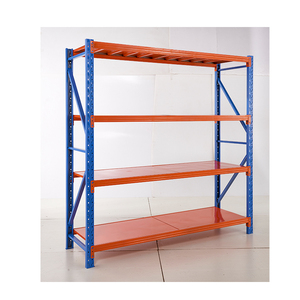
In modern logistics infrastructure, industrial metal shelving units and pallet racking systems form the high-density physical backbone of omnichannel distribution, cold chain logistics, and automated manufacturing. Navigating global manufacturing contracts demands deep engineering scrutiny into yield strengths, profile roll-forming integrity, electrostatic epoxy powder adhesion, and international safety compliance.
Precision-manufactured from high-tensile Q235B/SPCC cold-rolled steel coils, these 8 standard and customizable systems are engineered to withstand rigorous cyclic operations, seismic dynamics, and corrosive atmospheric stresses across international logistics corridors.
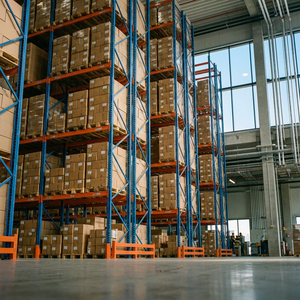
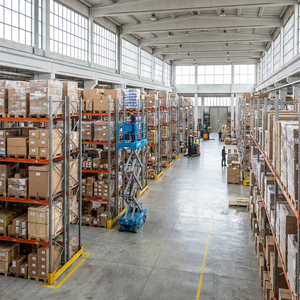
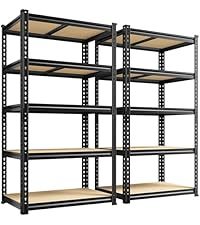
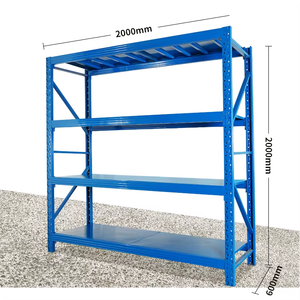
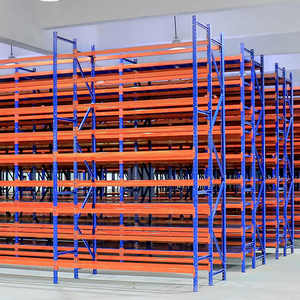
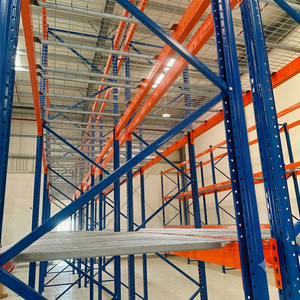
Direct-from-factory procurement requires an objective structural audit. Understanding steel grades, cold-forming dynamics, deflection tolerances, and automated surface treatments differentiates durable industrial assets from catastrophic structural failures.
Tier-1 factories source prime structural grade steel coils (predominantly Q235B, Q345B, ASTM A36, and SPCC) with verified mill test certificates (MTCs). Raw steel undergoes chemical spectrometry to regulate carbon, manganese, and silicon trace elements, ensuring tensile elongation beyond 26% and minimum yield strengths exceeding 235-345 MPa to prevent brittle structural rupture under dynamic impact.
Structural upright columns and horizontal load beams are processed through computerized continuous roll-forming lines featuring 18 to 24 cold-rolling passes. This progressive deformation preserves steel lattice integrity, mitigates micro-fractures, and achieves microscopic profile dimensional tolerances within ±0.15mm, guaranteeing seamless starter-and-add-on modular bay alignment.
Surface durability is dictated by automated chemical pre-treatment: degreasing, zinc-phosphating, multi-stage reverse osmosis rinsing, and passivating. Components pass through robotic electrostatic spray booths where thermosetting polyester or epoxy-polyester powder is cured at 200°C for 20 minutes, generating a continuous 65–90 micron dry film thickness (DFT) surpassing 500 hours of ASTM B117 salt spray testing.
Compare load ratings, structural profiles, deflection benchmarks (L/200), and operational picking dynamics to align engineering parameters with precise facility operational workflows.
| System Classification | Typical Load Rating | Upright & Beam Profile | Deflection Limit | Handling & Access Mode | Application Environment |
|---|---|---|---|---|---|
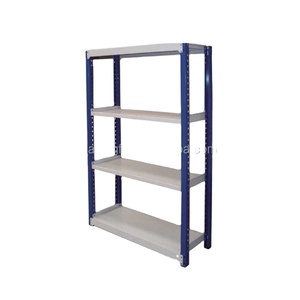
| Light-Duty Boltless Shelving | 100 - 300 kg / Shelf | Angle Post 38x38x1.5mm, Rivet Beams | ≤ L / 200 | Manual Hand Picking (100% Direct) | E-commerce, Auto Spares, Workshops |
| Medium-Duty Longspan Shelving | 300 - 800 kg / Level | 55x47mm Omega Upright, P-Beams | ≤ L / 250 | Manual / Order Picker Cart | Carton Flow, Bulky Archives, Backroom |
| Selective Pallet Racking | 1,000 - 4,500 kg / Level | 80-120mm Uprights, Box / Step Beams | ≤ L / 200 (FEM 10.2.02) | Counterbalance / Reach Truck | Logistics 3PL, FMCG, Cold Warehouses |
| Drive-In Pallet Racking | 1,000 - 2,000 kg / Pallet | Heavy Reinforced Upright & Top Tie | ≤ L / 200 Rigid Rail | Drive-in Forklift (LIFO / FIFO) | High-Density Bulk & Deep-Freeze Storage |
| Cantilever Racking Systems | 500 - 3,000 kg / Arm | IPE Hot-Rolled or Welded C-Profile | ≤ L / 150 Cantilever | Side Loader / Overhead Crane | Pipes, Timber, Extrusions, Sheet Metal |
| Mezzanine Storage Floors | 300 - 1,000 kg / m² | SHS/CHS Columns, C/Z Purlins | ≤ L / 300 Floor Slab | Multi-Tier Conveyor / Freight Lift | Vertical Space Duplication, Sortation |
| Galvanized Wire Mesh Decks | 500 - 1,500 kg Uniform | 4-6 Gauge Cold-Drawn Steel Wire | ≤ L / 200 Static | Pallet Drop / Case Picking Support | NFPA Fire Safety Sprinkler Compliance |
Structural steel storage hardware is transitioning from static metal fabrication into smart, low-carbon, robotics-integrated infrastructure. Major supply chain directors must evaluate five critical technological disruptions.
To reduce global ocean freight container dead-weight and lower raw material carbon footprints, export mills are actively re-engineering shelving components using HSLA micro-alloyed steels (containing vanadium, niobium, and titanium). This enables 15–22% gauge thickness reductions without sacrificing ultimate structural load limits, significantly reducing cost-per-pallet position.
E-commerce fulfillment centers are replacing manual forklifts with Autonomous Mobile Robots (AMRs) and Automated Storage & Retrieval Systems (AS/RS). Modern shelving units require tighter fabrication tolerances (under ±0.5mm over a 6-meter span), integrated seismic base plates, optical sensor targets, and low-friction galvanized guide rails suited for robotic shuttle navigation.
Environmental trade compliance—such as the European Carbon Border Adjustment Mechanism (CBAM)—is accelerating the phase-out of traditional heavy chemical chromates and energy-intensive hot-dip galvanizing. Leading factories are shifting to thin-film zinc-flake nano-coatings and low-temperature powder resins that decrease carbon intensity while providing up to 1,000 hours of corrosion protection.
Ocean shipping logistics remain a volatile cost center in B2B metal shelving procurement. Leading exporters utilize robotic nested packing and custom-engineered heavy-duty steel pallets to achieve container volume utilization rates exceeding 94%. Modular knock-down (KD) configurations eliminate empty air volume, lowering shipping damage claims to below 0.05%.
Procurement teams increasingly require Building Information Modeling (BIM) files and Finite Element Analysis (FEA) certifications prior to PO release. Tier-1 manufacturers provide Revit/AutoCAD parametric families and non-linear finite element stress simulations that model floor slab deflection, seismic rack interaction, and dynamic wind loading for semi-automated rack-supported buildings.
International cross-border buyers face strict municipal safety enforcement. Factories must certify load capacities under European EN 15512 / FEM 10.2.02, American RMI (Rack Manufacturers Institute) MH16.1, and Australian AS 4084 standards. Compliance includes seismic testing protocols for peak ground acceleration (PGA) zones and NFPA 13 in-rack fire sprinkler integration.
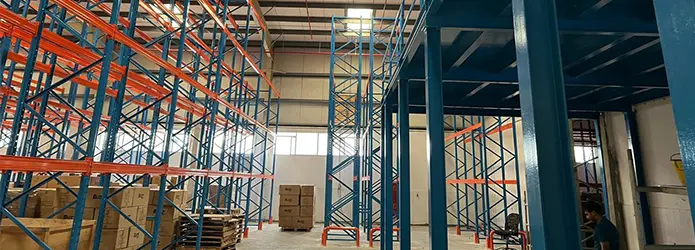
Operating from our advanced manufacturing and logistics terminal in Hamriyah Free Zone (Sharjah, UAE), Integrated Storage Solutions (ISS) delivers high-performance racking, longspan shelving, multi-tier mezzanines, and custom sheet metal enclosures tailored for demanding industrial operators.
Our engineering services encompass holistic logistics consulting, technology integration, and custom structural fabrication. We engineer layouts that prevent aisle congestion, eliminate floor slab stress fractures, and accelerate pallet throughput.
We analyze volumetric clear heights, column spacing, and inventory velocity profiles to configure narrow aisle (VNA), drive-in, or multi-tier structures that increase cubic storage density by up to 65% over conventional layouts.
Our certified inspectors conduct detailed dynamic load audits, checking upright verticality tolerances, anchor torque ratings, base-plate integrity, and fork truck collision damage in accordance with international safety mandates.
Supported by CNC fiber lasers, multi-axis press brakes, and robotic welding cells, we fabricate bespoke locker housings, custom shelf dividers, cantilever upright extensions, and heavy-duty galvanized structural frames.
Objective engineering answers addressing load factor ratios, international testing standards, surface finishing longevity, and supply chain logistics.
Under FEM 10.2.02 and RMI MH16.1 specifications, the maximum allowable deflection under uniformly distributed load (UDL) is L/200 for horizontal beams, where L represents clear beam span. For high-precision automated systems or sensitive electronics storage, stricter thresholds of L/300 or L/350 are often engineered into the beam profile.
Q235B is a structural carbon steel with a guaranteed minimum yield strength of 235 MPa, ideal for heavy-duty load-bearing uprights, frame trusses, and step beams. SPCC is commercial-quality cold-rolled carbon steel sheet characterized by superior surface smoothness, tight gauge tolerances, and high ductility, making it ideal for roll-formed shelf panels and rivet decking.
For extreme humidity, coastal salt mist, or non-temperature-controlled open logistics warehouses, hot-dip galvanizing per ISO 1461 (60–85 microns of sacrificial zinc alloy) delivers 25+ years of maintenance-free service. Alternatively, a dual-layer coating featuring a zinc-rich primer followed by architectural-grade polyester powder coating provides outstanding corrosion resistance.
Galvanized wire mesh decks offer critical fire safety compliance under NFPA 13 rules by allowing sprinkler discharge water to penetrate lower storage levels unobstructed. Furthermore, mesh decking permits ambient lighting and warehouse airflow, prevents dust accumulation, and provides non-slip, drop-prevention support for damaged or non-standard pallets.
Seismic calculations evaluate the geographical Peak Ground Acceleration (PGA), building importance factors, and site soil classification under EN 16681, AS 4084, or RMI standards. Uprights are engineered with expanded footplates, heavy-duty Hilti anchor bolts, and specialized top-tie cross bracings that dissipate ground-motion harmonics without column buckling.
Under international structural racking codes, a safety factor between 1.5 and 1.95 on yield limit is rigorously applied. This structural buffer guarantees that unexpected point-load concentrations, dynamic forklift placements, or minor pallet misalignments will not trigger progressive plastic deformation or catastrophic bay failure.
A Tier-1 export mill provides: (1) Raw material mill test certificates (MTCs) verifying chemical and tensile properties; (2) Certified factory weld test reports (WPS/PQR); (3) Powder coating dry film thickness (DFT) and cross-hatch adhesion records; (4) Formal static load test data per EN 15512; and (5) A detailed container loading plan.
Boltless rivet shelving employs keyhole-slot and dual-rivet drop-in connections, allowing complete assembly using only a rubber mallet in roughly one-third the time required for bolted slotted-angle systems. Slotted angle shelving relies on corner gusset plates, nuts, and bolts; while slower to erect, it offers continuous dimensional customization for tight, irregular utility footprints.
In high-density racking installations exceeding 8 meters in height, even microscopic floor slab variations magnify column out-of-plumb verticality at top beam levels. Facilities must verify floor flatness conforming to DIN 18202 or ACI 117 standards to eliminate hazardous frame leaning and ensure safe automated turret truck or reach truck operation.
By designing uprights and beams with interlocking nested profiles and fully knock-down (KD) end frames, factories eliminate trapped air in maritime shipments. Combined with computerized 3D container packing simulations, this achieves shipping densities exceeding 24 metric tons per 40ft high-cube container, significantly cutting landed freight expense per unit.
Whether you require standard 5-layer boltless rivet shelving, high-bay automated pallet racking, or bespoke laser-cut sheet metal infrastructure, our Sharjah engineering team delivers custom CAD layouts, certified load calculations, and global turnkey export support.
Get a Quote