Racking & Shelving Specialists — Hamriyah Free Zone, Sharjah · Serving the UAE & GCC
Explore our precision-fabricated heavy duty warehouse storage solutions. Sourced from high-tensile Q235B/Q355B structural steel, each system is calibrated for seismic resistance, dynamic pallet loading, and seamless automated material handling.
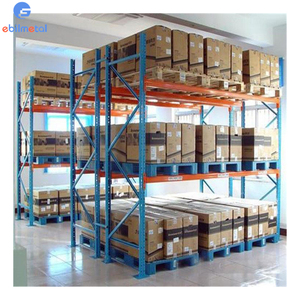
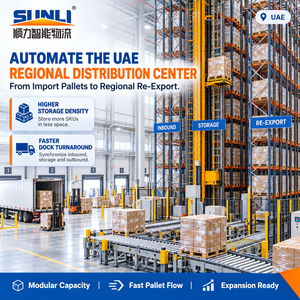
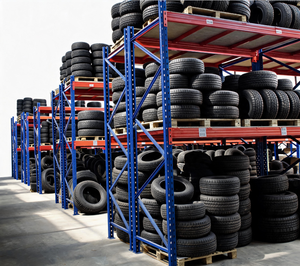
In high-density industrial logistics, structural integrity determines operational safety and asset longevity. Sourcing heavy duty racking directly from top China suppliers demands precise knowledge of metallurgical grades, roll-forming tolerances, connector mechanics, and dynamic load dissipation.
We strictly source prime continuous cast structural steel coils from tier-1 steel mills (Baosteel, Shougang). Featuring guaranteed yield strengths with Q235B (yield strength ≥ 235 MPa) and high-load Q355B (yield strength ≥ 355 MPa / 51,000 PSI), our cold-rolled steel profiles deliver optimal elongation characteristics and impact resilience under cold storage down to -30°C.
Upright columns undergo automated continuous roll-forming across 18 to 22 forming passes. The proprietary multi-ribbed Omega cross-section profile maximizes the radius of gyration, yielding superior torsional stiffness, buckling resistance, and load-bearing ratios per kilogram of steel without micro-fracturing along the cold-worked bending radii.
Beam end connectors are stamped from 3.5mm–4.5mm heavy-gauge alloy steel and welded using 6-axis robotic MIG systems under argon shielding gas. Equipped with 3, 4, or 5 drop-forged claw hooks and positive locking safety pins, our connections resist accidental upward dislodgement forces exceeding 5,000 N per beam end.
Steel components undergo automated degreasing, pickling, surface conditioning, and zinc phosphating prior to electrostatic powder deposition. High-grade TGIC-free epoxy-polyester thermosetting powder is cured at 200°C, producing a non-porous 80–120 μm coating thickness compliant with ISO 9227 salt spray resistance exceeding 500 hours.
Every rack installation is modeled through 3D ANSYS and SAP2000 structural finite element software. Systems are tailored to local seismic spectral response accelerations (Ss and S1) according to ASCE 7, Eurocode 8, and Chilean NCh 2369 standards, optimizing baseplate anchoring, bracing patterns, and moment-resisting beam frames.
Backing each deployment with 36 years of field engineering expertise spanning the UAE, GCC, Americas, and Europe, our technical teams lead every phase: site slab load assessment, dynamic material flow analysis, CAD/BIM modeling, export container packing optimization, and factory-certified on-site assembly supervision.
Selecting the correct heavy-duty racking topology requires balancing storage density, pallet selectivity, material handling equipment (MHE) constraints, and warehouse throughput dynamics. Review our structural performance matrix below.
| Racking System | Maximum Load Capacity | Space Efficiency | Pallet Selectivity | Standard MHE Required | Primary Industrial Application |
|---|---|---|---|---|---|
| Selective Pallet Racking | 1,000–4,500 kg / beam pair | Medium (40-45%) | 100% Immediate Direct Access | Counterbalance, Reach Trucks | FMCG, 3PL Distribution, General Manufacturing, High-SKU Retail Hubs |
| Drive-In / Drive-Through | 1,000–2,000 kg / pallet space | Very High (70-80%) | FILO (Drive-In) / FIFO (Drive-Through) | Narrow Counterbalance, Reach Trucks | Cold Storage Facilities, Beverage Bulk Warehousing, Homogeneous Goods |
| Push-Back Racking (Cart/Roller) | 1,500 kg / pallet slot (2–6 deep) | High (65-75%) | FILO by Lane Batch | Standard Reach & Counterbalance | Buffer Holding, Perishable Stock with Expiry Tracking, Cold Distribution |
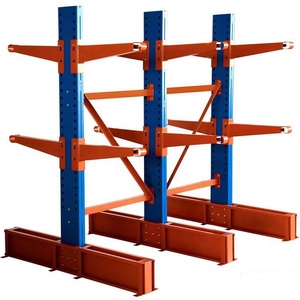
| Heavy Duty Cantilever Racks | 500–2,500 kg / support arm | Specialized Geometry | 100% Unobstructed Longitudinal | Side Loaders, 4-Way Combilifts | Timber Bundles, Steel Beams, PVC Piping, Aluminum Profiles, Heavy Plate |
| Automated AS/RS High-Bay | 500–2,000 kg / pallet (Up to 40m) | Maximum (>85% Cube) | 100% Automated Instant Access | Rail-Guided Stacker Cranes / AGV | Gigafactories, Pharma Cold Chambers, High-Throughput E-Commerce, Automotive |
| Heavy Duty Rack Mezzanines | 300–1,500 kg / m² floor slab | Double/Triple Usable Area | Continuous Multilevel Access | Pallet Jacks, Goods Lifts, Conveyors | Spare Parts Centers, Carton Picking Operations, Production Assembly Overheads |
Integrating modern Chinese heavy industrial manufacturing scale with over 36 years of direct regional engineering, installation, and compliance experience in the UAE, GCC, and across five continents.
Operating 24 continuous roll-forming lines, automated punch presses, and robotic gantry welding systems across our 60,000 m² production complex. By cutting out intermediary trading agents, clients capture direct Tier-1 mill economics and rapid production scaling for 500+ ton mega-projects.
All structural profiles are engineered and batch-tested to satisfy European standard EN 15512 (Steel Static Storage Systems), American RMI MH16.1, and Australian AS 4084 requirements. Independent weld ultrasonic testing and laboratory steel coupon yield tests ensure absolute zero-failure compliance.
Our operational integration with Integrated Storage Solutions (ISS) in Hamriyah Free Zone (Sharjah, UAE) provides regional technical support, localized stock, and bilingual site engineers for GCC clients, coupled with direct export shipping capabilities out of Shanghai, Qingdao, and Ningbo ports.
Industrial logistics is shifting toward higher densities, robotic automation, and aggressive carbon management. Procurement leaders must align structural racking capital investments with emerging technological and regulatory shifts.
Standard wide-aisle selective racking is increasingly being superseded by 4-way radio shuttle high-density systems and automated stacker crane integrations. Modern China racking suppliers now manufacture to millimeter-level tolerances (±1.0mm per 10m height) to guarantee laser scanner alignment, optical sensor tracking, and snag-free vertical shuttle transit in dark warehouses.
With the European Carbon Border Adjustment Mechanism (CBAM) and strict global ESG reporting, buyers are demanding Environmental Product Declarations (EPDs). Leading Chinese factories are incorporating electric-arc furnace (EAF) scrap-recycled steel coils, zero-heavy-metal zirconium pretreatments, and 100% recyclable powder coatings that eliminate VOC release during high-temperature curing.
Procurement contracts now require native Autodesk Revit and Tekla BIM (Building Information Modeling) objects at Level of Development (LOD) 300 to 400. This enables digital twin warehouse integration, live spatial conflict detection with sprinkler heads/HVAC ducts, and synchronized finite element modeling under real-time floor slab deflection conditions.
Driven by rapid cold-chain grocery expansion and coastal logistics hubs, demand is surging for dual-finish corrosion defense: hot-dip galvanizing (HDG) compliant with ISO 1461 (exceeding 85 μm zinc layer) alongside specialized Charpy V-notch tested steels that retain fracture toughness without ductile-to-brittle transitions at temperatures down to -35°C.
Direct, highly technical answers addressing structural calculations, international compliance, quality verification, and global logistics when purchasing from a China racking manufacturer.
From initial spatial survey to final structural handover, our standardized execution methodology ensures zero field deviations, on-time project delivery, and lifetime structural integrity.
We collect comprehensive operational data: warehouse clear ceiling heights, slab point-load capacities, column grid spans, building emergency egress routes, pallet dimensions (GMA, EUR, AU), gross cargo load profiles, SKU velocity (ABC analysis), and forklift turning radii.
Our structural engineering department produces full 2D AutoCAD equipment layouts, 3D BIM integration files, and SAP2000 finite element calculation calculations. We verify aisle widths, rack flue clearances, ESFR sprinkler penetration, and dynamic beam-column rotational stiffness.
Steel profiles are punched, cold-roll-formed, laser-trimmed, and robotically welded. Continuous quality control measures dimensional hole-pitch accuracy, beam connector weld throat penetration, and powder coat film thickness before issuing strict factory clearance certificates.
Bundled profiles are strapped with heavy PET banding, lined with edge corner protectors, and sealed in waterproof shrink barrier wrap. Our container logistics team executes precision balance stowage plans to ensure maximum payload utilization and zero ocean transit abrasion damage.
Experienced installation teams plumb upright columns using optical laser theodolites, install expansion anchors to calibrated torque limits, insert safety beam pins, apply official load rating plaques, and conduct dynamic proof-testing alongside warehouse stakeholders before sign-off.
Whether optimizing an existing facility or engineering a greenfield automated high-bay distribution center, our direct China factory engineering team delivers precision CAD layouts, structural calculations, and competitive pricing within 24 hours.