Custom OEM Tire Storage Racks Manufacturers & Suppliers in the Toronto Market
Precision-engineered heavy-duty modular tire racking systems, high-density stack racks, and seasonal changeover storage architectures tailored for automotive logistics across Greater Toronto and Southern Ontario.
OEM Heavy-Duty Catalog
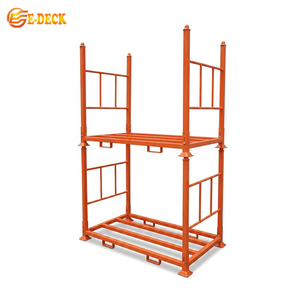
Engineered Tire Racking & High-Density Stacking Units
Direct factory-manufactured industrial tire storage solutions built from certified Q235B/Q345 structural steel. Optimized for standard passenger, SUV, light commercial, and heavy-duty bus/truck (TBR) wheel assemblies in compliance with Ontario warehouse safety standards.
Overcoming Warehouse Real Estate Pressures in the Greater Toronto Area (GTA)
The Greater Toronto Area (GTA)—encompassing key logistics corridors in Peel Region (Mississauga, Brampton), York Region (Vaughan, Markham), and Halton (Milton, Oakville)—represents one of North America's most critical distribution hubs. However, industrial floor space in Southern Ontario carries steep lease costs, tight availability rates, and strict municipal building codes. Facility operators and supply chain executives managing tire inventory cannot afford unoptimized square footage or horizontal floor spreading.
Tire storage presents distinct structural challenges compared to standard palletized consumer packaged goods (CPG). Unmounted rubber casings and mounted tire-wheel assemblies are circular, flexible, non-rigid loads that exert continuous horizontal wedging force against upright framing. Storing tires flat on conventional wood pallets causes severe tread deformation ("flat spotting"), degrades bead seating edges, and creates severe safety hazards due to structural load shifting. OEM-engineered custom steel tire storage racks resolve these challenges by converting dead vertical space into high-density storage while maintaining immediate SKU selectivity.
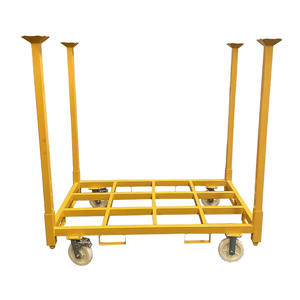
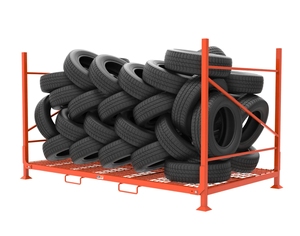
Strategic Takeaway for Ontario Fleet & Wholesale Operations: Stacking demountable or foldable steel tire racks 4 to 5 tiers high can triple cubic warehouse capacity without requiring building expansion or offsite lease commitments. This addresses the 65% seasonal inventory surge experienced during Ontario’s bi-annual tire changeover cycles.
The Bi-Annual Ontario Tire Changeover: Managing Unprecedented Inventory Surges
Unlike southern climates, Southern Ontario operates on a mandatory seasonal tire regime. Between late October and mid-December, hundreds of thousands of light passenger vehicles, commercial service vans, and municipal utility trucks transition to designated winter-rated rubber (bearing the three-peak mountain snowflake symbol). Between April and May, the inverse changeover occurs as fleets return to all-season or performance rubber.
This dynamic creates severe operational challenges for commercial tire dealers, 3PL providers, and automotive dealership groups. Warehouses must store off-season tire sets for up to six months, followed by rapid retrieval within a condensed four-week operational window. Rigid, fixed racking systems waste enormous cubic volume once tires are retrieved. Our OEM folding and demountable stack racks feature a 4:1 reverse folding ratio. Once spring deliveries conclude, empty racks fold flat and nest together, reclaiming up to 75% of active floor space for standard logistics and general cargo operations.
Tier-1 3PL & Wholesale Hubs
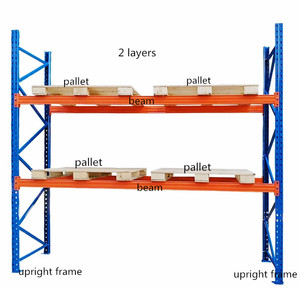
Installed across mega-distribution facilities along Highway 401, 407, and 410 in Brampton and Mississauga. Engineered to integrate with high-reach counterbalance forklifts and order pickers, providing maximum vertical clearance up to 32 feet clear-ceiling heights.
Dealership "Tire Hotels"
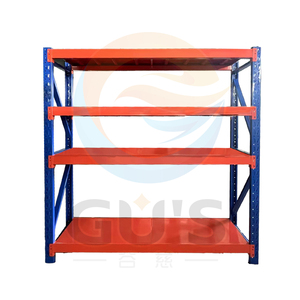
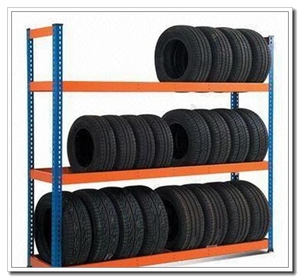
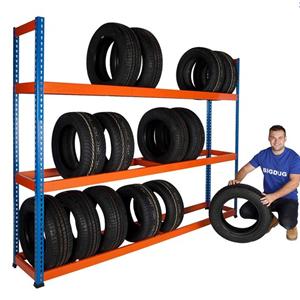
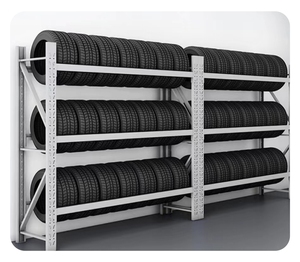
Automotive dealer groups across Vaughan, Richmond Hill, and Markham require dedicated, barcoded customer tire storage. Custom multi-tier boltless long-span shelving organizes seasonal wheel sets by customer ID, preventing rim rim-face scratching.
Municipal Transit & Freight Yards
Heavy commercial transit authorities, school bus yards, and cross-border transport carriers utilize custom structural TBR (Truck, Bus, and Radial) racks rated for tire diameters exceeding 44 inches with individual load capacities up to 3,000 kg.
Engineering Anatomy: Structural Integrity, Steel Grades & Fire Code Safety
Not all warehouse racking is built to withstand dynamic heavy loads. Racking systems deployed in Canadian industrial environments must satisfy rigorous metallurgical, structural, and life-safety performance criteria:
Our OEM tire racks are fabricated exclusively from certified high-tensile Q235B and Q345 structural grade carbon steel. Upright posts, tubular beam frames, and nesting cups undergo precision laser cutting, CNC roll forming, and robotic carbon-dioxide shielded continuous welding. Beams are engineered with calculated barrel cradles and ergonomic resting angles that distribute tire casing weight across the full perimeter of the tread band, preventing inner-liner pinches and sidewall fatigue during extended storage.
2. Ontario Fire Code (OFC) & NFPA 13 Compliance
In the province of Ontario, warehouse tire storage is strictly governed under the Ontario Fire Code (OFC) Section 3.2 and NFPA 13 (Standard for the Installation of Sprinkler Systems). Rubber tires represent an extraordinarily high heat-release commodity (Class VII commodity rating) capable of producing intense, rapidly developing fires with toxic hydrocarbon smoke. Storage configurations that block vertical water penetration from ceiling ESFR (Early Suppression, Fast Response) sprinklers fail municipal fire inspections.
Our OEM racks feature engineered open-mesh deck options, calibrated barrel spacings, and designated longitudinal and transverse flue clearances (minimum 6 inches to 12 inches continuous opening). This ensures compliance with local fire prevention authorities in Toronto, Mississauga, and Brampton while permitting fire suppression water penetration directly to the lower tire tiers.
Rack Model / Class
Primary Material
Unit Payload (kg)
Stacking Limit
Key Ontario Standard Compliance
Heavy-Duty Stacking Rack (Modular)
Q235B Cold-Rolled Hollow Section
1,200 kg / tier
Up to 5 units high
OFC Sec 3.2 / CSA S16
Industrial Folding Car Tyre Rack
Q345 Low-Alloy Structural Tube
1,000 kg / tier
4 units high (Loaded)
OHSA Pre-Start Review Ready
Structural Factory Beam Rack
Hot-Rolled Structural I-Beam / Box
3,000 kg / level
Engineered to Roof Clear
National Building Code (OBC)
Long-Span Boltless Medium-Duty
Step Beam with Structural Post
600 kg / shelf
Manual / Pick-Level
ANSI MH16.1 Industrial Standard
Commercial 5-Layer Dealership Rack
Powder-Coated Tubular Steel
400 kg / tier
Floor-Anchored
Retail Public Safety Rated
Emerging Market Trends: Preparing Toronto Warehouses for the EV Era
The automotive landscape across Ontario is experiencing an unprecedented structural transformation driven by zero-emission vehicle mandates and rapid Electric Vehicle (EV) adoption. For warehousing engineers and parts directors, EVs introduce substantial new logistical complexities:
1. The 25-30% Weight Penalty of EV Tires
Because battery packs significantly increase total vehicle curb weight, dedicated EV replacement tires (such as Michelin e-Primacy, Pirelli Elect, and Goodyear ElectricDrive) require reinforced internal constructions, extra steel belts, and specialized bead chafer wraps. A standard passenger EV tire often carries an Extra Load (XL) or High Load (HL) index, resulting in an assembly that is 20% to 30% heavier than a conventional internal combustion engine (ICE) counterpart.
Warehouses utilizing older, lower-spec sheet-metal shelving or light-duty pallet racking risk localized structural sagging and beam deflection when loading full sets of EV tires. Our custom OEM racks account for these updated dynamic weight curves, utilizing reinforced gussets, heavier gauge wall thicknesses, and redundant weld seams to ensure safety margins remain above 2.0x theoretical yield stress.
2. Acoustic Foam Liners and Environmental Sensitivities
Most modern EV tires integrate an internal polyurethane sound-dampening acoustic foam band adhered to the inner liner. Storing these tires in uninsulated structures or exposing them to excessive localized heat or chemical vapours can cause adhesive breakdown and foam detachment. Our storage configurations support proper vertical barrel rolling or horizontal nested orientation, eliminating focal pressure points that damage acoustic liners.
Manufacturing Authority
36 Years of Engineered Storage Excellence: Factory Direct to Toronto
We combine over three decades of international racking engineering with precision custom OEM manufacturing, delivering structural storage systems directly to distribution hubs across Canada.
Bespoke Engineering & CAD
Every facility layout begins with a technical assessment of your slab loading, clear height, and forklift turning radiuses, delivering millimeter-accurate CAD designs.
Certified Steel Standards
We use premium Q235B/Q345 structural steel, ensuring structural load integrity under extreme industrial temperatures and harsh operational demands.
Advanced Dual Coating
Automated powder coating lines deliver durable, impact-resistant finishes that withstand road salts, slush, and high-frequency warehouse impact.
End-to-End Project Support
From initial design studies to custom prototype fabrication and volume container delivery to your GTA dock, our single-team workflow ensures complete accountability.
Procurement Guidance
Frequently Asked Questions: Toronto Tire Racking Procurement
Key engineering, regulatory, and logistics questions answered by our storage specialists to assist facility managers and purchasing teams.
Do custom tire storage racks require a Pre-Start Health and Safety Review (PSR) in Ontario?
Under the Ontario Occupational Health and Safety Act (OHSA) Section 7, steel storage racks exceeding standard industrial thresholds or carrying altered configurations require an engineering review (PSR / PSHSR) signed by a licensed Professional Engineer (P.Eng). Our OEM manufacturing processes supply full technical data packages, weld inspection certifications, and FEA stress calculation sheets to expedite PSR sign-off across Ontario municipalities.
How does the Ontario Fire Code impact vertical tire stacking heights?
The Ontario Fire Code Section 3.2 categorizes rubber tire storage as a high-hazard operational commodity. Maximum stacking heights depend directly on the building's fire sprinkler system (standard density versus ESFR systems), clear distance to sprinkler heads (minimum 36 inches required for tires), and continuous transverse/longitudinal flue openings. Our custom stack racks are built with integrated flue standoffs to ensure code compliance at maximum vertical height.
What is the optimal orientation for storing customer-mounted wheel assemblies?
Mounted wheel assemblies (tires mounted on alloy or steel rims) are significantly heavier than unmounted casings. For retail dealership "tire hotels", tires should be stored vertically on their tread bands within barrel-cradled beams, or stacked horizontally only in custom stack racks with protective dividers to avoid metal-to-metal contact with decorative alloy rim faces.
What are the standard lead times for custom OEM volume orders shipped to Toronto?
Standard OEM production lead times range from 3 to 5 weeks depending on order volume and custom powder-coating requirements. Ocean freight to intermodal container yards in Toronto/Brampton via Montreal or Vancouver averages 3 to 4 weeks. We also offer dedicated container drop-shipping directly to your loading docks in Mississauga, Milton, or Vaughan.
Can your stackable tire racks accommodate heavier electric vehicle (EV) tires?
Yes. We engineer customized high-capacity stack racks designed specifically for Extra Load (XL) and High Load (HL) EV tire assemblies. By utilizing upgraded 2.5 mm to 3.0 mm steel wall tubing, reinforced post base plates, and heavy-duty nesting targets, our racks maintain standard safety factors even when loaded with high-curb-weight EV wheel assemblies.
How do demountable posts compare to folding frames for seasonal operations?
Demountable post racks allow posts to be removed from corner sockets and bundled, which is ideal when rack footprints rarely change but height reconfigurability is desired. Folding frames feature integrated heavy-duty hinges; they collapse in seconds without loose components, making them the preferred choice for rapid spring/fall changeovers in fast-paced 3PL environments.
Request a Custom Engineered Tire Storage Proposal
Connect with our technical design team today. Provide your building dimensions, clear-ceiling heights, and tire inventory volume to receive custom CAD layout options and factory-direct volume pricing for the Toronto market.