Racking & Shelving Specialists — Hamriyah Free Zone, Sharjah · Serving the UAE & GCC
Explore our certified portfolio of heavy-duty industrial cantilever structures, high-density coil supports, and modular storage hardware configured for Nordic warehousing facilities, manufacturing workshops, and regional timber distribution terminals.
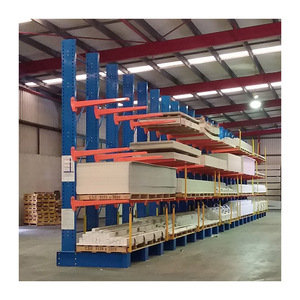
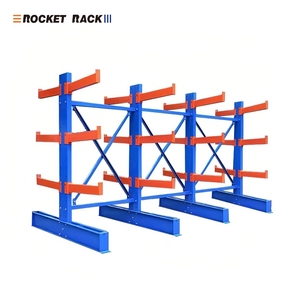
Deploying heavy-duty cantilever racking in Sweden requires advanced structural considerations that transcend conventional indoor racking designs. Warehouses from Skåne to Norrbotten are subject to stringent Swedish Work Environment Authority (Arbetsmiljöverket) guidelines and the national application of Eurocode 3 (SS-EN 1993-1-1) via Boverket’s Building Regulations (BBR). Cantilever systems must maintain exceptional elastic yield resilience against asymmetric live loading, longitudinal forklift impacts, and sub-zero brittle transitions.
Our heavy-duty cantilever columns are manufactured from certified structural steel (S235JR and high-tensile S355JR/J2). Unlike light cold-rolled profiles that suffer from localized torsional buckling under unilateral loads, our heavy lines leverage hot-rolled I-profiles (IPE or HEA/HEB sections). These hot-rolled members deliver an intrinsically superior radius of gyration, ensuring that tall uprights (exceeding 8 to 12 meters) maintain structural equilibrium without lateral bracing failure.
Arm-to-column connections are engineered utilizing precision-machined heavy pivot pins or multi-bolt high-friction connection nodes with 8.8 or 10.9 grade tensile bolts. The pivoting arm mechanism offers vital self-relieving safety: when an operator striking an arm upwards with a side-loader, the arm articulates upward rather than transferring fatal torsional bending moments into the column spine.
| Engineering Attribute | Standard Hot-Rolled (IPE/HEA) | Cold-Formed Light Profile |
|---|---|---|
| Material Yield Strength | S355JR / S355J2 (355 N/mm²) | Q235 / S250GD (235-250 N/mm²) |
| Arm Deflection Limit | 1/200 to 1/300 according to EN 15620 | 1/100 to 1/150 (prone to creep) |
| Impact Failure Mode | Plastic deformation with warning | Abrupt local buckling rupture |
| Corrosion Resistance | Hot-Dip Galvanized ISO 1461 (70–100µm) | Thin Pre-galv or Standard Paint |
| Max Arm Loading | Up to 5,000 kg Uniform Distributed | Typically capped at 800 kg |
| Sub-Zero Service Temp | Rated down to -40°C with J2 Charpy | Restricted to indoor > -5°C |
| SS-EN 15635 Audit Rating | Tier 1 Industrial Heavy Grade | Tier 3 Commercial Medium Grade |
From the dense forestry sectors of Småland to the automotive manufacturing networks in Gothenburg and the infrastructural hubs in Mälardalen, cantilever systems must solve precise dimensional and material handling challenges.
Sweden’s forestry heartlands in Småland, Dalarna, and Värmland require continuous outdoor storage of timber packs, kiln-dried structural lumber, and glulam beams (limträbalkar). Cantilever racks equipped with integral shed canopies (grenställ med tak) protect valuable timber from heavy rain and snowmelt while maintaining uninterrupted front-loading access for 4-way sideloader trucks.
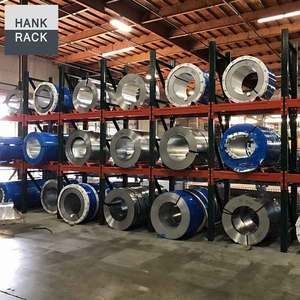
Supplying the automotive and heavy equipment clusters across Gothenburg, Trollhättan, and Bergslagen demands heavy cantilever setups for cold-rolled steel coils, long stainless steel profiles, and solid rounds. Utilizing customized V-shaped cradles and drop-in saddles prevents roll displacement and ensures crane slinging safety under strict Arbetsmiljöverket health and safety mandates.
Sweden leads Europe in industrial timber housing and volumetric modular architecture (modulbyggande). Our custom long-arm cantilever solutions (with arm reaches up to 2,000 mm) accommodate complete wall framing cassettes, truss bundles, and insulated pre-cast components, minimizing ground handling damage and cutting staging cycle times inside automated modular factories.
Major wholesale hubs along the E4 corridor in Jönköping, Stockholm, and Malmö route tens of thousands of copper, PEX, cast-iron, and PVC plumbing pipe bundles daily. High-density cantilever configurations equipped with vertical arm retaining pins and removable pipe sockets prevent rolling, maximizing vertical warehouse height utilization without risking picking aisle avalanches.
Procurement teams in Scandinavia are prioritizing carbon transparency, automated fleet integration, and outdoor yard density to tackle rising warehouse construction costs and aggressive environmental goals.
Swedish buyers increasingly demand certified Environmental Product Declarations (EPDs) aligned with EN 15804. Driven by national green building accreditations like Miljöbyggnad and BREEAM-SE, procurement contracts require suppliers to demonstrate reduced embodied carbon, recyclability, and traceability across the steel smelting chain, accelerating adoption of electric-arc-furnace (EAF) components.
With high Swedish labor costs, facilities are transitioning from manual diesel counterbalance trucks to automated electric 4-way sideloaders and inductive wire-guided VNA (Very Narrow Aisle) systems. Cantilever engineering has evolved to incorporate heavy bottom floor guide rails (styrskenor) with millimeter deflection tolerances to prevent mechanical interference with high-speed automated mast extensions.
High municipal building permit hurdles and rising industrial lease rates in Stockholm and Gothenburg push logistics operators to convert unconditioned exterior tarmac into high-density storage. Cantilever structures engineered with integrated roof trusses, snow-retention brackets, and windward back-cladding allow operators to gain sheltered square meters at a fraction of greenfield construction costs.
Drawing on over three decades of racking and industrial shelving engineering, our consultative project methodology guarantees structural safety, certified traceability, and turn-key operational precision.
Comprehensive data capture covering slab thickness, concrete compressive strength, seismic zones, and Boverket snow/wind maps (up to 4.5 kN/m² in northern Sweden).
3D CAD and Finite Element Analysis (FEA) testing of column stability, second-order $P$-$\Delta$ effects, and arm deflection profiles tailored to your handling fleet.
Laser profiling, robotic submerged-arc welding, and hot-dip galvanization conforming to EN ISO 1461. Complete mill test certificates (MTR) according to EN 10204 3.1.
Experienced installation teams following SS-EN 15635 protocols, ensuring chemical/expansion anchor bolt torques, column shimming, and laser level trueness.
Handover includes certified load warning notices (belastningsskyltar) compliant with Swedish workplace safety standards and annual inspection schedules.
Key technical, regulatory, and logistics questions addressed by our chief structural engineers to assist Nordic supply chain directors and facility managers.
Cantilever racking installed in Sweden must comply with SS-EN 15512 (structural design principles for steel static storage systems), SS-EN 15620 (tolerances, deformations, and clearances), and SS-EN 15635 (application and maintenance of storage equipment). When installed outdoors with roof canopies, the rack becomes a civil structure subject to Eurocode 1 (SS-EN 1991) and Eurocode 3 (SS-EN 1993) under Boverkets byggregler (BBR), dictating strict snow and wind load calculations based on the regional Swedish snow zone (snözon 1.0 to 4.5).
For unconditioned outdoor yards, open timber sheds, or facilities situated within 20 km of Sweden's western coastline (e.g., Bohuslän, Gothenburg), hot-dip galvanization conforming to SS-EN ISO 1461 is imperative. The marine humidity and high atmospheric salt content (Corrosivity Categories C4 and C5-M) rapidly breach standard epoxy coatings. Our hot-dip treatment applies 70 to 100 microns of metallurgical zinc alloy, guaranteeing over 25 years of corrosion-free exterior service without peeling or oxidation.
Standard low-grade carbon steels undergo ductile-to-brittle transitions at temperatures between 0°C and -15°C, making them vulnerable to shattering under impact from a forklift fork. For installations in Dalarna, Jämtland, Norrland, or unheated interior terminals, we supply hot-rolled steel profiles with Charpy V-notch energy ratings of at least 27 Joules at -20°C (S355J2) or -40°C (S355K2). This retains structural elasticity and prevents brittle fracturing even during severe Scandinavian winters.
Most Swedish cantilever operations use 4-way electric reach trucks or dedicated multidirectional sideloaders (e.g., Combilift, Hubtex). The clear operating aisle width ($A_{st}$) is determined by the total chassis width plus the load depth, plus an extra 500 mm safety clearance ($2 \times 250\text{ mm}$ side tolerance according to SS-EN 15620). If guided mechanical floor rails or inductive floor wire tracks are installed, this aisle clearance can be safely condensed to 100–150 mm on either side, recovering up to 30% of warehouse floor footprint.
Cantilever uprights exert massive point loads combined with overturning bending moments ($M_y$) at the baseplate connection. A standard 150 mm unreinforced slab is frequently inadequate for cantilever columns exceeding 6 meters loaded to 15,000 kg total column capacity. We evaluate your floor concrete grade (typically C25/30 or C30/37) and slab thickness to design extended baseplates with chemical anchor arrays (M16/M20 Hilti or Fischer systems) that distribute shear and pullout forces without spalling the concrete substrate.
Under Arbetsmiljöverkets föreskrifter (AFS 2006:4) and European standard SS-EN 15635, warehouse operators are legally bound to conduct ongoing visual safety checks (weekly/monthly by a designated Person Responsible for Racking Safety - PRRS) and mandatory annual inspections performed by a certified independent racking inspector (besiktningsman). All damage to cantilever arms, base anchors, and upright verticality must be logged and categorized according to Green, Amber, or Red hazard thresholds.
Standard tailored engineering and factory production cycles require 4 to 6 weeks. Ocean freight directly to Port of Gothenburg (Göteborgs Hamn), Port of Helsingborg, or Port of Stockholm (Norvik Hamn) typically adds 24 to 32 transit days. We manage comprehensive DDP/CIF commercial logistics, handling Swedish customs import clearance, port de-consolidation, and flatbed transport directly to your project job site anywhere across Sweden.
Retrofitting a canopy to existing indoor-rated cantilever columns is structurally hazardous unless originally pre-engineered for environmental wind and snow loads. A roof assembly acts as an aerodynamic wing, creating massive tensile uplift during storm gusts and high downward compressive stresses during heavy blizzards. We recommend configuring uprights as "canopy-ready" during initial production, ensuring column section modulus and foundation footings account for future exterior exposure.
Submit your warehouse floor plans, product dimensions, load weights, and equipment specifications. Our structural storage consultants will deliver an optimized CAD layout proposal, static load validation report, and transparent quotation for your Swedish operations within 48 hours.